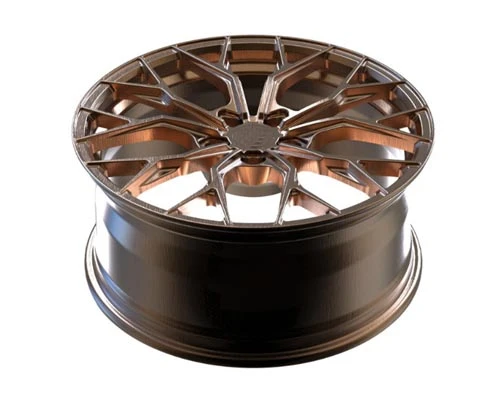
Aluminum alloy wheels are a type of automotive wheel primarily manufactured from aluminum-silicon (AlSi) alloys. Characterized by their light weight, rapid heat dissipation, and excellent vibration-damping properties, they are widely used in both passenger vehicles and racing cars. Manufacturing techniques include gravity casting, low-pressure casting, and flow forming. The material used is predominantly A356 aluminum alloy-containing elements such as aluminum, silicon, and magnesium-with structural design and process optimization employed to achieve a balance between low weight and high strength.
The manufacturing process for alloy wheels typically involves several stages: melting, casting, heat treatment, and machining. Melting entails mixing various metallic elements in specific proportions and heating them until molten. Casting involves pouring the molten alloy into a mold, where it cools to form the wheel's initial shape. Heat treatment-comprising heating, holding at temperature, and cooling-is used to improve the wheel's internal microstructure and performance characteristics. Finally, machining processes such as turning and milling are employed to ensure the wheel meets precise dimensional and shape specifications.