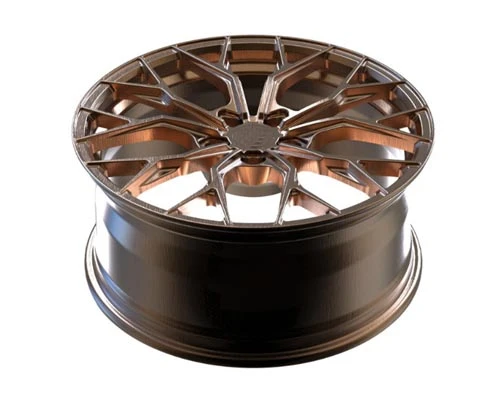
There are two primary forms of wheel rims: deep-well rims and flat-base rims. Other types include split rims, semi-deep-well rims, wide deep-well rims, wide flat-base rims, and full-tapered-base rims.
Deep-Well Rims
This type of rim is a single-piece unit featuring a deep recessed groove in the center of its cross-section. It is primarily used for passenger cars and light off-road vehicles. It features flanged shoulders designed to seat the tire beads; these shoulders typically slope slightly toward the center-usually at an angle of 4 to 6 degrees-with the maximum diameter of the sloped section serving as the bead seat diameter. The deep central groove facilitates the mounting and dismounting of the tire. Deep-well rims offer a simple structure, high rigidity, and low weight, making them ideal for smaller, highly elastic tires. However, large, stiff tires are difficult to mount onto this type of single-piece rim.
Flat-Base Rims
Available in various structural configurations, this type of rim is commonly used on trucks in my country. It utilizes a solid retaining ring (1) secured by an open-ended, elastic locking ring (2) to prevent the retaining ring from slipping off. During installation, the tire is first placed onto the rim, followed by the retaining ring, which is pushed inward past the rim's annular groove; the open elastic locking ring is then seated into that groove.
Split Rims
This type of rim consists of two parts-an inner section and an outer section-which may have equal or unequal widths and are bolted together as a single unit. Dismounting or mounting a tire simply requires removing the nuts. A detachable retaining ring (3) is used; in some designs, the retaining ring is omitted in favor of a flange integrated into the inner rim section, with the inner rim welded to the wheel disc.
As the rim serves as the foundation for mounting and securing the tire, the location and extent of tire deformation vary depending on the rim used. Therefore, it is best to pair each tire specification with its designated standard rim; if necessary, a rim with specifications close to the standard (an "allowable rim") may be used. Using an unsuitable rim can lead to premature tire damage, particularly when the tire is mounted on a rim that is too narrow.